|
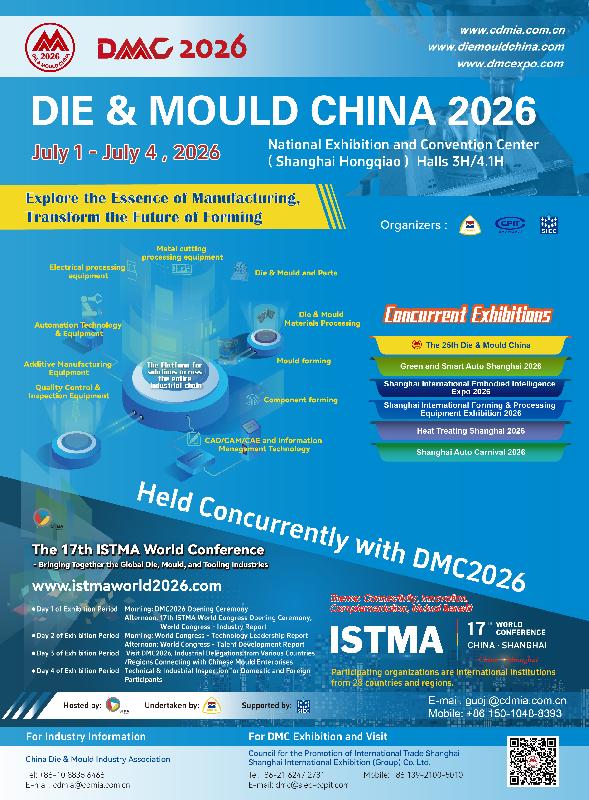
The 17th ISTMA (International Special Tooling & Machining Association) World Conference was held from 1 to 4 July 2026 at the Xijiao State Guest Hotel, Shanghai. This marked the first time in ISTMA's history that the World Conference was hosted in China by China Die and Mould Industry Association (CDMIA) , organized by the ISTMA. The conference brought together over 250 delegates, including international representatives from 13 countries and regions alongside domestic industry participants. Under the theme "Connectivity, Complementarity, Innovation, Win-Win," the conference featured 18 presentations across three thematic sessions: Industry Research, Technology Leadership, and Talent Development.
Opening Addresses: Building Consensus, Setting Direction
Hosted by the Ryan Huang,Vice president of ISTMA,Several special guests invited to given the welcome address at the opening ceremony. Li Qi, Vice President of the China Machinery Industry Federation, noted that China's die and mould output had reached 380 billion yuan with exports exceeding 10.2 billion US dollars, solidifying its position as a critical link in the global supply chain. Liu Xiaohu, Executive Vice President of CDMIA, affirmed that "it is precisely our shared challenges that create the foundation for cooperation." Academician Tan Jianrong of the Chinese Academy of Engineering delivered a keynote address, approaching the topic from fundamental scientific questions in kinematics and dynamics to propose five application directions for "AI + die and mould."
Session I: Industry Research — A Global Perspective
Chaired by ISTMA President Bob Williamson, five speakers examined the current state and trends of the die and mould industry from diverse regional perspectives:
Stephan Berz (President, ISTMA Europe; Germany) — Highlighted that global die and mould overcapacity stands at approximately 30%, calling for strengthened upstream-downstream collaboration in front-end design and after-sales service, drawing lessons from China's long-termist approach.
Christian Dihlmann (Vice President, ISTMA; President, ABINFER, Brazil) — Presented Brazil's "PODIUM" strategy, advancing the mould industry through five pillars: professional training, technology, market access, tax policy, and sustainability.
Tapiwa Samanga (President, ISTMA Africa; CEO, PtSA, South Africa) — Using the data point of merely 40 vehicles per 1,000 people in Africa, outlined a vision to establish five die and mould industry hubs across the continent by 2035.
Kai Yu (Senior Consultant, WBA Aachen, Germany) — Demonstrated the CCC cross-company comparison tool, leveraging a database of over 3,000 enterprises and 207 KPI indicators to deliver quantitative competitiveness diagnostics for individual companies.
Fausto Romagnani (Past President, ISTMA; Italy) — Argued that the unit of competition in global manufacturing has shifted from individual enterprises to ecosystems. Italy's precision manufacturing and China's scale capability, he noted, are complementary rather than competitive.
Session II: Technology Leadership — From Process Knowledge to Intelligent Execution
Michael Mayer (Head, DMG MORI Die & Mould Competence Center) — Showcased the MX transformation framework, integrating multiple machine-tool operations into a single multi-tasking five-axis machining center to achieve process integration and green manufacturing.
Michael Palmieri and Du Ning (Makino Milling Machine Co., ) — Revealed the technological pathway from process knowledge bases to intelligent execution agents in die and mould machining automation: the core asset is shifting from the tacit experience of veteran craftsmen to reusable process intelligence agents.
Tony Wong (Product Manager, United Maching Solutions) — Spark-tracking technology enables real-time adaptive control in EDM, reducing wire electrode consumption by up to 40% in extreme cases.
Zeng Kai (Vice President of Operations, Lanchi Cutting Tools) — Proposed a progression path for domestic cutting tools from price-based substitution to equivalent-performance substitution, achieving full-process precision control with a tolerance of 0.003 mm across the entire product line.
Justin Barnes (Executive Director, Toyota Wessels Institute for Manufacturing Studies) — Through data analysis, revealed the deep interconnections between the die and mould industry and the broader manufacturing economy, distilling nine lessons for emerging economies.
Kong Xiangxing (Head of China, Tebis AG) — Pointed out that the real bottleneck in manufacturing efficiency lies not in processing speed but in process waiting time, proposing a five-layer AI application pyramid model.
Session III: Talent Development — Diverse Pathways, Shared Imperative
António Pontes (Professor, University of Minho) — Presented research demonstrating that conformal cooling channel design through additive manufacturing reduces mould weight by 75% and shortens cycle time by nearly 40%.
Lu Fanrong (General Manager, Yimo Digital Technology) — Traced the 70-year evolution of digitalization in China's die and mould industry, illustrating the pathway from standalone tools to full-process integration through three factory case studies.
Liang Zhenghua (Chairman, Zhejiang Kaihua Mould) — Shared 15 years of industry-academia integration practice, with over 20 million yuan invested in building an industry college that delivers customized talent pipelines ready for immediate deployment upon graduation.
Zhang Junlin (Marketing Director, Beijing Shichuang Technology) — Introduced the four-year exploration of the "Shichuang Cup" mould design competition, which lowers the barrier to simulation through a unified cloud-based toolset and promotes the development of digital design standards across the industry.
Dai Yuwei (President, Tianjin Education Research Association) — The Luban Workshop has now been recognized in 32 countries with 38 accredited programs, and its "localized instructor training" model is evolving from "following enterprises abroad" to "leading enterprises abroad."
Thomas Eberius (Chief Engineer, WZL Laboratory, RWTH Aachen) — Showcased practical applications of AI agents in the die and mould value chain, emphasizing that AI deployment requires multi-dimensional feasibility assessment.
Concurrent Events
DMC2026 China International Die & Mould Technology and Equipment Exhibition (1–4 July, National Exhibition and Convention Center, Shanghai). The exhibition covered the full industrial chain, from precision equipment and mould manufacturing to high-end materials. Procurement delegations from Europe, Asia, and the Middle East conducted on-site business matching. ISTMA member association representatives and international manufacturing procurement groups visited the exhibition.
ISTMA 2026 General Meeting (3 July). The Assembly approved the "ISTMA World Mould Maker Certification" framework and completed the presidential election — Christian Dihlmann (Brazil) was elected as the new ISTMA President for the 2026–2029 term. The Assembly also ratified the composition of the new Board of Directors and Supervisory Board.
Plan Tours (3 July afternoon – 4 July full day). International delegates visited three representative enterprises — Hangzhou Yusei Industrial, Shanghai Yesun Mould, and Taicang Yiben Machinery — for in-depth discussions and exchanges on AI applications in mould design, full-chain vertical integration of stamping moulds, and automated production line design and flexible adaptation, respectively.
Significance
The 17th ISTMA World Conference represents a significant milestone in China's die and mould industry deepening its integration into the global arena. The 18 presentations across three sessions covered the full spectrum from macro-industry trends to micro-level technology applications, while the concurrent exhibition, annual assembly, and plant tours together formed a comprehensive "conference + exhibition + site visits" structure. The ISTMA General Meeting completed its leadership transition, and the establishment of the "World Mould Maker Certification" framework has laid the groundwork for international mutual recognition of talent qualifications. The consensus forged under the theme of "Connectivity, Complementarity, Innovation, Win-Win" — that innovation knows no borders and collaboration is the path forward — will provide enduring momentum for the coordinated development of the global die and mould industry in the decade ahead.
|